Store The Sun.
Skip The Peak.
Solar covers what your building uses while the sun is up. A battery covers the fifteen minutes that set your demand charge — the part of the bill panels alone can't reach.
Solar covers what your building uses while the sun is up. A battery covers the fifteen minutes that set your demand charge — the part of the bill panels alone can't reach.
Watch a weekday on a commercial roof. The panels do the work from morning to late afternoon. The battery fills on the surplus at midday and empties into the evening peak — the hours the utility bills at the highest rate, and the hours that set your demand charge for the whole month.
Four things, in the order they matter for a commercial customer in the Northeast. The first one is why most of our storage conversations start.
Commercial utilities bill you for your single highest 15-minute draw each month, on top of the energy you use. On the buildings we've analyzed that line runs 36–51% of the bill. The battery discharges into exactly those minutes, so the meter never records the spike.
Con Edison, PSEG Long Island and Eversource price afternoon and early-evening power far above overnight power. The battery fills when electricity is cheap or free — from your own roof — and empties when it's expensive. Same kilowatt-hours, lower price.
A distribution center or a bakery runs at night. Without storage, midday surplus goes to the grid for a credit; with storage it stays on site and runs the second shift. That matters most where net-metering credits are worth less than the retail rate you'd otherwise pay.
A correctly designed system keeps critical loads — refrigeration, controls, life safety — running through an outage, without a diesel generator to fuel and test. It is a smaller share of the financial case than the three above, and for a cold-storage operator it can be the reason to do the project.
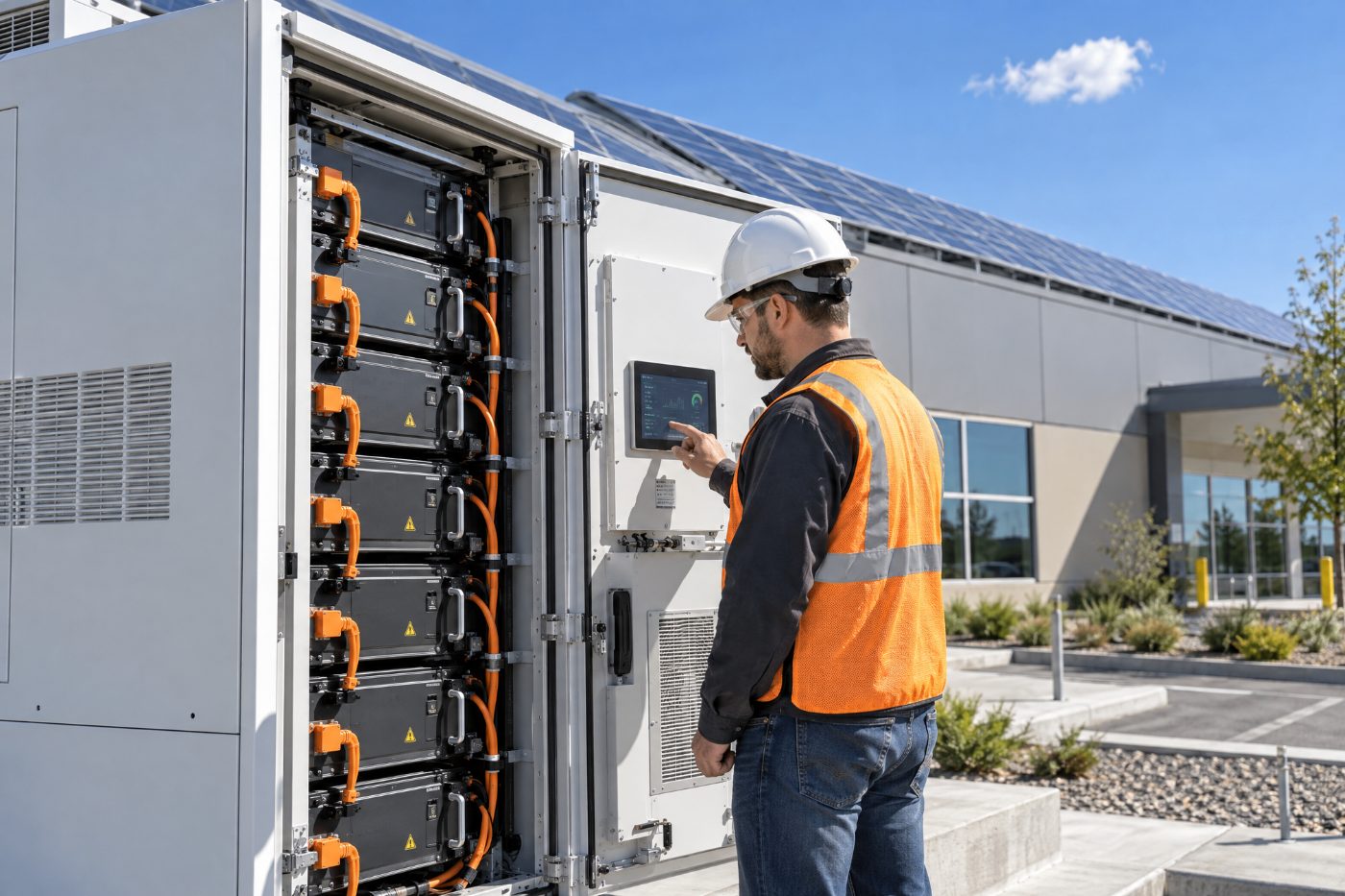
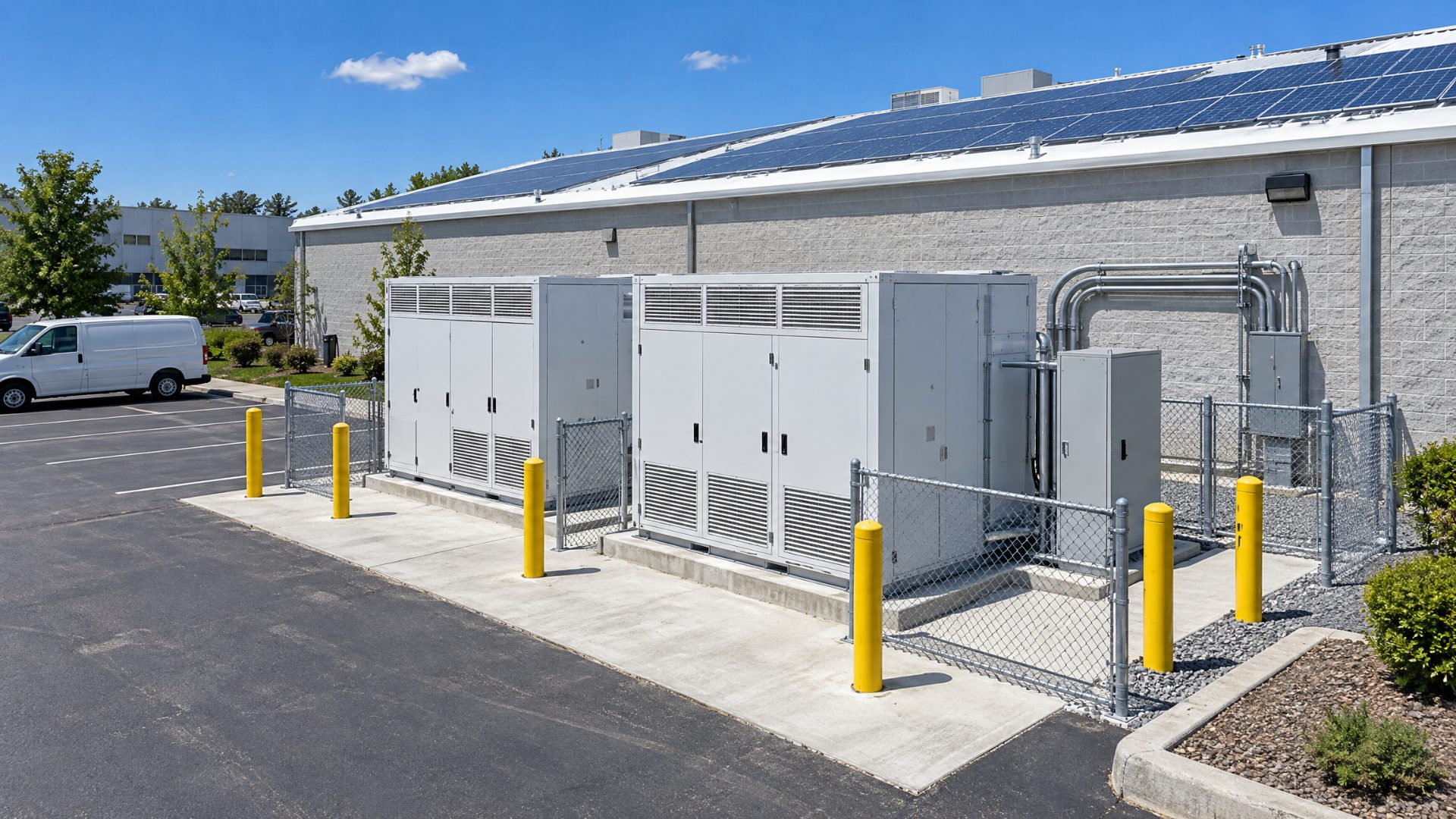
A commercial system is an outdoor enclosure on a concrete pad — about the footprint of two parking spaces for the sizes we typically design — with four things inside.
Lithium iron phosphate cells. Chosen over the chemistry in your phone because they don't thermally run away, they last 6,000–10,000 cycles, and they contain no cobalt. UL 9540A tested.
The inverter that moves power both ways — DC from the cells to AC for the building, and back again to charge.
Watches every cell's voltage and temperature and keeps the pack balanced. This is the safety layer.
The brain. It reads your load, the solar output and the utility's price schedule, and decides — minute by minute — when to charge and when to discharge. This is where the demand-charge savings actually come from.
An indoor sports facility on Long Island: winter-heavy load, a sharp summer peak, a PSEG Long Island time-of-use rate that charges $34.91 per kW of summer demand. Solar alone would have covered the energy and left most of the demand charges standing. The design pairs 159 kW of solar with a 100 kW / 406 kWh battery.
See the full analysis on The NumbersThe federal credit that no longer applies to new commercial solar still applies to batteries. That changes which half of a project carries the incentives.
Battery storage — standalone or paired with solar — qualifies for a 30% investment tax credit under Section 48E, with additional adders for domestic content and energy-community locations. On the Long Island system's $310,000 battery, the base credit alone is $93,000.
A battery is five-year property. Bonus depreciation on the post-credit basis is worth roughly another quarter of the system cost to a profitable business — your accountant confirms the rate, we model it to the dollar.
NYSERDA's storage incentives, New Jersey's storage program and the Connecticut and Massachusetts equivalents each run on their own schedules and step down as funding is used. We calculate what applies to your project on the day of your assessment, not from a number on a website.
Tell us about your building and your bill. We'll tell you what share of it is demand, whether a battery pays on your rate schedule, how big it should be, and what the incentives look like today. No cost, no obligation.